
Beyond "Tokyo Swindlers": Navigating Real Estate Risks and the Critical Role of Escrow in Japan
Introduction: The Allure and the Shadow of the Japanese Market
The Japanese real estate market is currently experiencing a historic wave of interest from global investors. Driven by the depreciation of the yen, a stable political climate, and the enduring value of assets in cities like Tokyo and Osaka, High-Net-Worth Individuals (HNWI) and family offices are flocking to Japan to capitalize on high-quality opportunities.
However, beneath the surface of this mature and orderly market lies a unique, historical risk that often catches foreign investors off guard. If you have recently watched the hit Netflix series Tokyo Swindlers (known locally as Jimenshi-tachi), you may already be aware of Japan's specialized group of real estate fraudsters known as "Jimenshi" or "Land Sharks."
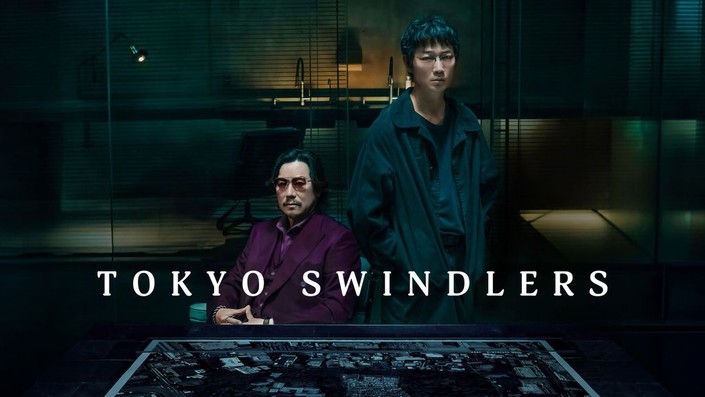
Citation: Promotional image from the Netflix Original Series "Tokyo Swindlers" (2024). Copyright © Netflix. All rights reserved.
While the dramatization is entertaining, the risk is real. For international investors, the danger lies not in the market value of the property, but in the opacity of the transaction process itself. Unlike in Western jurisdictions where Escrow accounts are standard, Japanese real estate transactions often rely on simultaneous settlement—a practice that leaves a critical window of vulnerability.
At Property Concierge Japan, we believe that successful investment requires more than just access to off-market listings; it requires a sophisticated shield against these unique local risks. In this article, we deconstruct the Jimenshi phenomenon, explain why the Japanese system is vulnerable, and detail how our concierge services utilize Escrow structures to guarantee the safety of your capital.
Decoding the "Jimenshi": Who Are the Land Sharks?
To protect your assets, you must first understand the adversary. The term "Jimenshi" (地面師) is a compound of three Japanese characters: Ji (Land), Men (Face/Surface), and Shi (Master/Specialist). Historically, these were fraudsters who specialized in impersonating landowners to sell property they did not own.
Unlike common online scams, Jimenshi operations are highly sophisticated, offline crimes involving elaborate teams of professionals. A typical Jimenshi group operates like a theater troupe, casting roles such as:
The Impersonator
A person who physically resembles the real owner and is trained to mimic their mannerisms and signature.
The Frontman
The negotiator who interacts with the buyer's agents.
The Forger
A specialist capable of creating near-perfect counterfeits of passports, driver's licenses, and, most importantly, the Hanko (personal seal) registration certificates.
What They Target
They do not target average apartments. They hunt for high-value "off-market" land or buildings—specifically those unencumbered by mortgages and owned by elderly individuals or those living away from the property. These properties are attractive to investors because they are rare and valuable, making the buyer eager to close the deal quickly.
Case Study: The 5.5 Billion Yen Lesson
The threat of Jimenshi is not a relic of the past, nor is it limited to inexperienced buyers. The most infamous case in recent history occurred in 2017, involving Sekisui House, one of Japan's largest and most respected housing developers.
The Incident
Sekisui House negotiated to purchase a prime plot of land in Gotanda, Tokyo, for 5.5 billion yen (approximately $50 million USD at the time). The "seller" was an imposter posing as the elderly owner (who was actually hospitalized and unaware of the sale). Despite warnings from the real owner via verified mail (which were dismissed or ignored by the corporation), the deal proceeded.
The Failure Point
Pressure to secure a prime development site led the company to rush the due diligence process. They paid the full amount before the title transfer was officially registered by the Legal Affairs Bureau. By the time the bureau rejected the registration due to forged documents, the money had been dispersed to dozens of disparate bank accounts and withdrawn.
This incident proved a chilling fact: If a domestic giant with a dedicated legal team can be deceived, a foreign investor navigating the market remotely is significantly more exposed without the right partner.
For specific details on how the fraud was executed and the internal findings, you can refer to the official investigation report by Sekisui House (PDF).
Structural Vulnerabilities: Why Does This Happen in Japan?
Foreign investors often ask: "How is this possible in a country known for its safety and high trust?" The answer lies in the structural differences between Japanese and Western real estate practices.
AThe "Hanko" Culture vs. Digital Identity
While Japan is modernizing, real estate still relies heavily on the Hanko (personal seal) and physical Seal Registration Certificates. While culturally significant, these physical items are easier to forge than biometric data or digital signatures. A skilled Jimenshi team can replicate a seal and its corresponding certificate with terrifying accuracy.
BThe "Settlement Gap" (The Critical Flaw)
In the UK, US, or Australia, funds are typically held in an Escrow account managed by a lawyer or title company. The seller does not receive the money until the title has legally transferred to the buyer.
In Japan, the standard practice is "Simultaneous Settlement" (Doji-Kessai).
- The buyer, seller, real estate agents, and a Judicial Scrivener (Shiho-shoshi) meet in a bank room.
- Documents are handed over.
- The buyer executes a wire transfer to the seller immediately.
- After the money moves, the Judicial Scrivener takes the documents to the Legal Affairs Bureau to file for registration.
The Risk: There is a time lag—typically ranging from several days to a week—between the payment of funds and the official update of the property registry. It is in this "blind spot" that Jimenshi operate. If the documents are later found to be forgeries, the registry rejects the application, but the money is already gone.
The Missing Safeguard: Why Escrow is Not Standard
You might assume that using an Escrow account is a simple request. However, in the Japanese domestic real estate market, Escrow services are extremely rare.
Most domestic real estate agents and sellers resist Escrow because:
It adds time and cost to the transaction.
Japanese business culture relies heavily on mutual trust and face-to-face confirmation.
There is a lack of established Escrow infrastructure for general consumers.
For a foreign investor, this refusal to use Escrow is a "red flag." For a Japanese seller, it is simply "the way things are done." This cultural and procedural gap is where deals often collapse—or where investors are forced to take unnecessary risks.
The Solution: Property Concierge Japan's Approach
At Property Concierge Japan, we exist to bridge this gap. We understand that High-Net-Worth investors demand a level of security that standard Japanese brokerage firms often fail to provide.
Our mission is to offer a "Concierge" experience that goes beyond mere introductions. We provide a one-stop solution covering tax, legal, and operational support, with a core focus on risk elimination.
Our Defense Strategy Against Fraud:
Implementation of Escrow Services
We actively coordinate Escrow arrangements for our clients. By utilizing reputable trust companies or legal escrow services, we ensure that your funds are never released to the seller until the Judicial Scrivener and the Legal Affairs Bureau have verified the authenticity of the transfer. This effectively neutralizes the Jimenshi risk.
Deep-Dive Due Diligence (KYC)
We do not rely solely on paper documents. Our team, working with experienced legal professionals, conducts rigorous background checks on off-market listings, including:
- Physical Verification: Direct meetings with owners and neighbors to confirm identity.
- "Rights to the Road" & Boundary Checks: Ensuring the asset is legally sound.
Exclusive Off-Market Access
Jimenshi often prey on outsiders trying to access "secret" deals. By sourcing properties through our vetted, closed network of trusted domestic partners, we filter out the noise and the risk before a proposal ever reaches your desk.
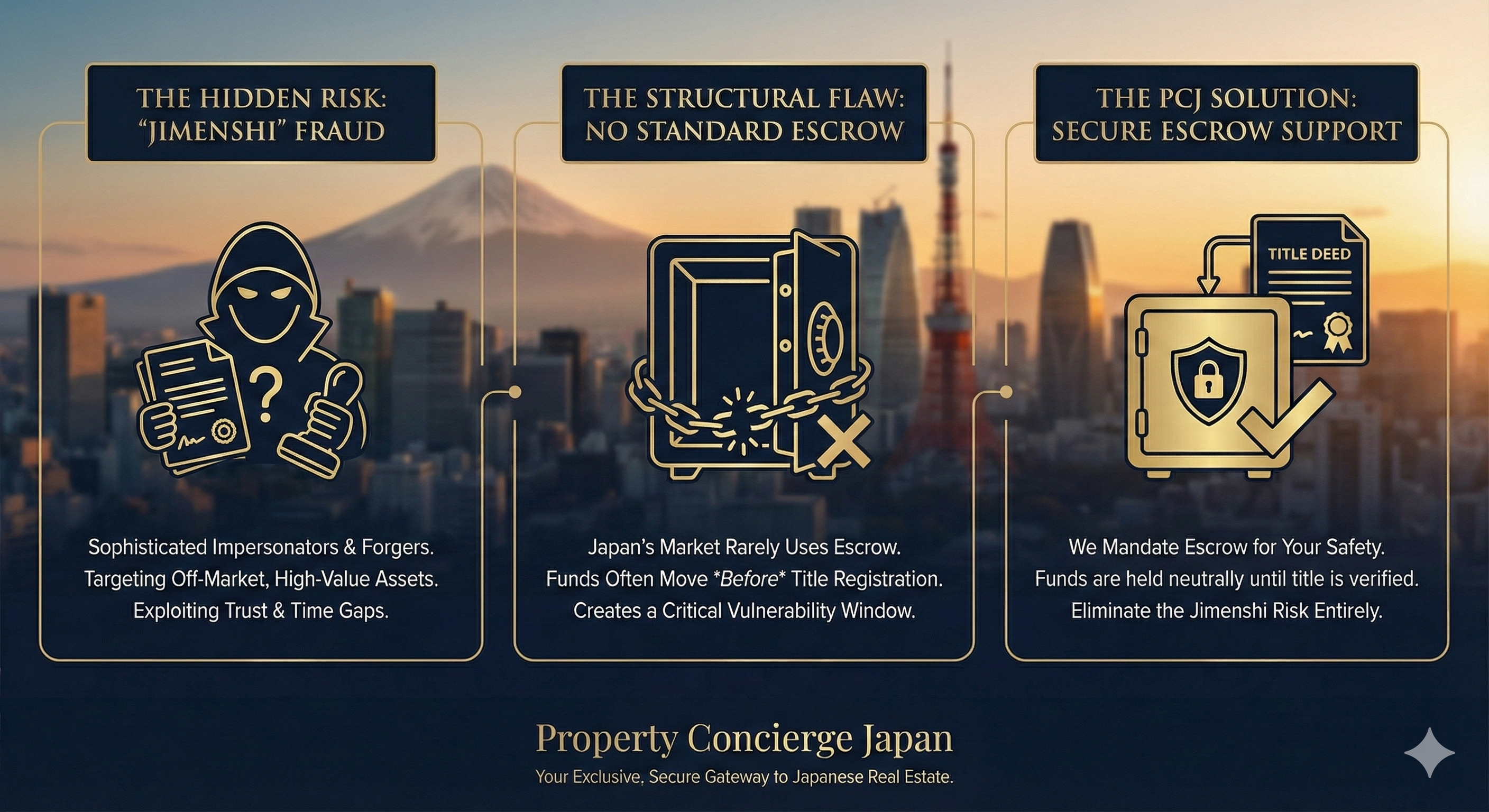
FAQ: Understanding the Risk
Q: Is Jimenshi only a risk for foreigners?
A: No. Domestic companies and professionals have been victimized, including major corporate actors like Sekisui House. However, foreign investors are often targeted because they may be less familiar with local verification procedures and the nuances of Japanese documentation.
Q: If Japan has a real estate registry, why can fraud still happen?
A: Because the fraud often happens at the transaction stage—through impersonation, forged authority documents, and pressure to pay—before the Legal Affairs Bureau has had the chance to verify the seller and update the registry.
Q: Is escrow standard in Japan?
A: No. Many legal and industry overviews state that escrow is generally not used and is not common in typical Japanese real estate closings. This is why working with a specialized partner who can arrange escrow is vital.
Q: What is the single most effective countermeasure?
A: A layered approach is essential: Strict seller verification (KYC) + Escrow-controlled payments to ensure funds are protected until the title is secure.
Conclusion: Invest with Confidence, Not Blind Trust
Japan remains one of the most attractive real estate markets in the world for wealth preservation and capital appreciation. The existence of Jimenshi should not deter you from investing; rather, it should highlight the importance of choosing the right partner.
Navigating the Tokyo market requires more than just a broker; it requires a guardian who understands both the local terrain and global compliance standards.
Property Concierge Japan is your gateway to exclusive, off-market Japanese real estate, secured by world-class legal and financial protocols. We handle the complexity of tax, law, and security so that you can focus on the value of your investment.
Are you ready to access Japan's premium real estate market safely?
Contact Property Concierge Japan TodayContact Us TodayLet us secure your legacy in Japan.