
Unlocking Japan's Real Estate Potential: How Low Interest Rates Make It a Global Investment Hotspot
Introduction
If you're reading this, you likely already know that the Japanese Yen is historically weak. It's the kind of currency arbitrage opportunity that makes headlines. But there's another financial lever in Japan that is arguably even more powerful for the savvy investor: leverage itself. While the rest of the world is grappling with interest rate hikes that eat into profit margins, Japan remains an outlier. The Bank of Japan (BOJ) has held firm on a monetary policy that keeps borrowing costs exceptionally low. For a Next-Gen investor looking for high-risk, high-return opportunities, this divergence in global monetary policy isn't just a curiosity—it's a strategic advantage.
Why does this matter? Because cheap debt amplifies ROI. When your cost of borrowing is a fraction of your yield, your cash-on-cash return skyrockets. In this deep dive, we're going to look at exactly how you can access this cheap financing. We will cover the specific mechanisms for non-resident investors to secure loans, comparing the stark differences in global interest rates, and outlining the precise steps—like establishing a Japanese corporate entity—thatcan unlock these doors. Let's get straight to the numbers.
Japan's Anomaly: The Longstanding Low-Interest Rate Environment
First, let's look at the macro environment. The Bank of Japan has pursued an ultra-loose monetary policy for decades to combat deflation and stimulate economic growth. While the Federal Reserve and the ECB have aggressively hiked rates to cool inflation, the BOJ has largely maintained its "Yield Curve Control" (YCC) policy. This policy keeps the 10-year Japanese Government Bond (JGB) yield—the benchmark for long-term lending rates—anchored at incredibly low levels.
For you as a real estate investor, this policy translates directly into cheaper mortgages. When banks can borrow money cheaply, they can lend it cheaply. This stability is rare in today's volatile global market. It provides a predictable cost basis for your investment models, allowing you to project cash flows with a higher degree of confidence than in markets where variable rates are currently spiking unpredictably.
Global Comparison: The Interest Rate Gap
To understand the scale of this opportunity, you need to see the data side-by-side. We are comparing investment property loans, not residential home loans (which are even lower). In major global hubs, the cost of capital has surged. Here is a snapshot of typical interest rates for real estate investment loans as of late 2024/early 2025:
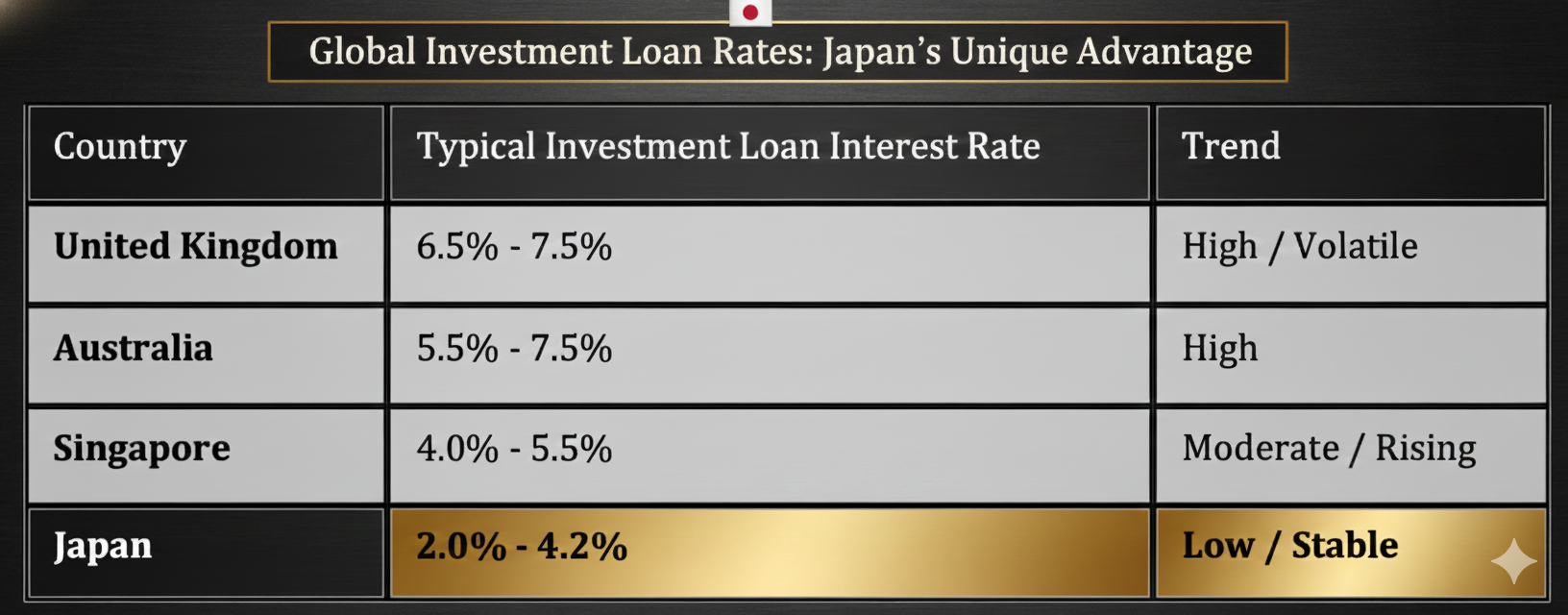
The math is simple. If you are buying a commercial building in Osaka yielding 5.5%, and your borrowing cost is 7% (like in the US), you are in negative leverage territory—the debt is dragging down your returns. In Japan, if that same building yields 5.5% and you borrow at 3.0%, you have positive leverage. You are making a spread on the bank's money. This "yield gap" is the primary driver of capital inflow into Japanese real estate right now.
The Hurdle: Can Non-Resident Foreigners Secure Loans?
Here is the friction point. Japanese banks are notoriously conservative. Their risk models usually require the borrower to reside in Japan, have permanent residency, and earn income in Yen.
The General Rule
For most Japanese mega-banks (Mitsubishi UFJ, SMBC, Mizuho), lending to a non-resident individual is a non-starter. They simply do not have the underwriting capability to assess foreign credit risk.
The Exceptions
However, the landscape is not entirely closed. Specific institutions have recognized the appetite from foreign HNWIs and have built products to serve them.
Tokyo Star Bank
This is the most prominent player for individual investors. They offer loans to non-residents, provided they reside in specific regions (often Taiwan, Hong Kong, and occasionally Singapore or China).
Regional Banks
Some regional banks in areas like Fukuoka or Hokkaido, eager to stimulate local investment, may consider loans if the property is local and the LTV (Loan-to-Value) is conservative.
Overseas Branches
Sometimes, if you have a strong relationship with a Japanese bank branch in Singapore or Hong Kong, they can facilitate a loan for a Japan property, though this is often essentially a loan booked offshore, not a domestic Japanese loan.
While these options exist, they often come with lower LTV ratios (50-60%) and slightly higher rates than what a local resident would get. So, how do you unlock better terms and higher leverage? You localize.
The Strategic Pathway: Establishing a Japanese Corporation (GK/KK)
The most reliable route for a non-resident foreigner to access Japanese bank financing is to establish a local corporate entity. The two most common structures are:
Godo Kaisha (GK)
Similar to an LLC
Lower setup cost, simpler governance, and often preferred for holding real estate.
Kabushiki Kaisha (KK)
Similar to a Corporation
More formal structure, better for scaling or if you plan to bring in multiple investors.
Once your entity is registered, you can open a corporate bank account and apply for a corporate loan. The bank evaluates the entity's creditworthiness, not just yours personally. This is critical because it allows you to build a track record in Japan, even if you have no prior credit history in the country.
Key Requirements:
Registered office address in Japan (can be a virtual office initially)
Representative director (can be you, but must have a registered seal—hanko)
Capital injection (minimum ¥1 for a GK, though banks prefer to see meaningful equity)
Corporate bank account (requires in-person visit or power of attorney)
The incorporation process typically takes 2-4 weeks if handled by a competent judicial scrivener (shiho shoshi). Once your entity is live, you can immediately begin the loan application process.
What Do the Terms Look Like? (Corporate Loan Snapshot)
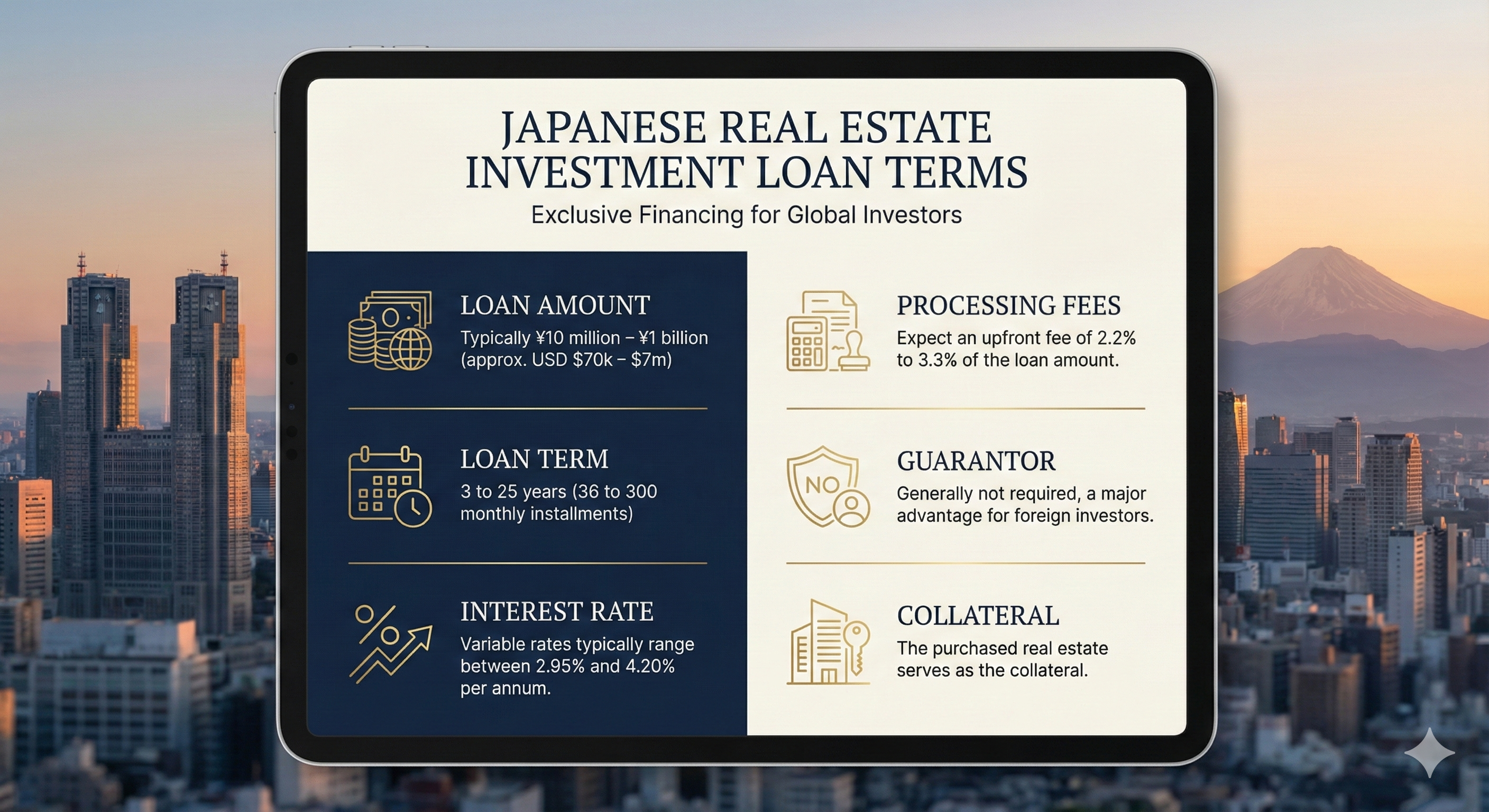
Let's get specific. If you set up a GK and apply for financing, what can you expect? Based on current market conditions for a newly established SPV (Special Purpose Vehicle) owned by a foreign investor, here are realistic terms:
Loan Amount
¥10M - ¥1B
Typically ranges from ¥10 million to ¥1 billion (approx. USD $70k - $7m). This range covers everything from a robust condo portfolio in Fukuoka to a decent-sized commercial building in Osaka.
Loan Term
3 - 25 Years
3 to 25 years (36 to 300 monthly payments). Note: The term often depends on the remaining statutory useful life of the building. Concrete (RC) buildings hold value longer and get longer loan terms.
Interest Rate
2.95% - 4.20%
Variable rates typically between 2.95% and 4.20% per annum. While this is higher than the <1% rates offered to salarymen buying homes, it is remarkably cheap compared to the 8% commercial rates seen elsewhere globally.
Processing Fees
2.20% - 3.30%
Expect an upfront fee of 2.20% to 3.30% of the loan amount. Always factor this into your acquisition cost model.
Guarantor
Not Required
Generally not required. This is a massive benefit. Non-recourse style lending (where the loan is secured only by the asset) is rare in Japan for smaller ticket sizes, but many corporate loans for foreigners are "limited recourse," meaning no personal guarantor is needed if the LTV is managed correctly.
Collateral
Property Only
The purchased real estate acts as the collateral.
The ROI Multiplier: Leveraging Low-Cost Financing
Let's run a hypothetical scenario to demonstrate the power of this financing.
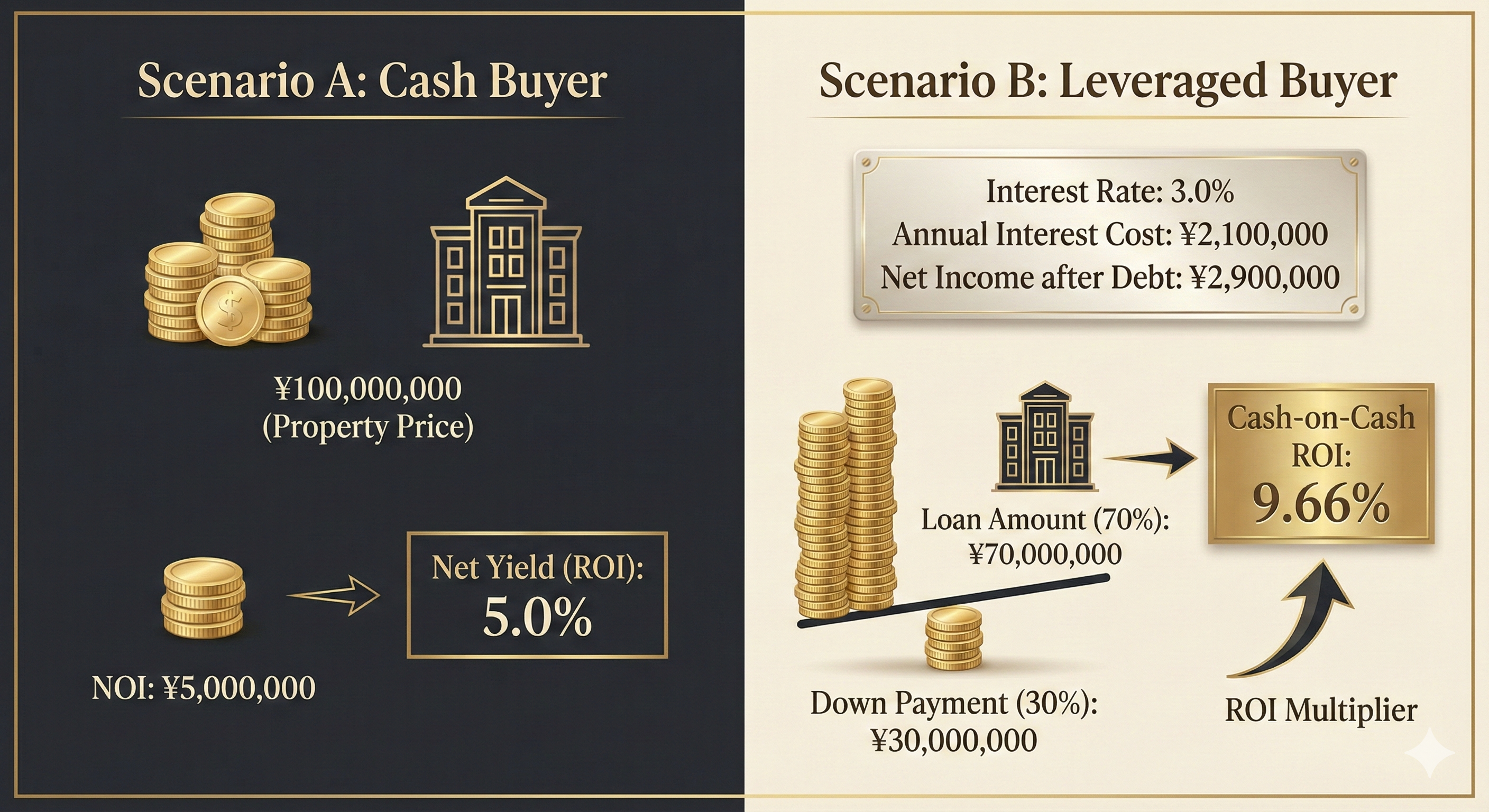
The Power of Leverage: By utilizing cheap Japanese debt, you have almost doubled your return on equity from 5.0% to nearly 9.7%. This is the "secret sauce" of Japanese real estate. It allows you to control larger assets with less capital, amplifying your capital gains when you eventually exit. For an investor prioritizing capital gains in high-growth corridors like Osaka or Fukuoka, this leverage allows you to acquire more square footage today, positioning you to capture more appreciation tomorrow.
Overcoming the Friction: Property Concierge Japan
The opportunity is clear, but the execution is heavy. Japanese bureaucracy is legendary—paperwork, hanko stamps, in-person meetings, and language barriers can kill a deal's momentum. For a mobile-first investor who values speed and efficiency, traditional Japanese processes are a bottleneck. You don't want to spend months flying back and forth to sign documents.
This is where Property Concierge Japan operates. We function as your boots on the ground, but with a digital-first interface.
Our One-Stop Solution Includes:
Off-Market Access
We use AI-driven insights to curate properties that aren't on public portals—specifically targeting high-yield assets in Tokyo and Fukuoka.
Entity Setup
We handle the entire incorporation process for your GK or KK, coordinating with judicial scriveners to get your entity registered fast.
Banking Relations
We don't just introduce you to banks; we prepare the credit packages in the format Japanese bankers need to see, significantly increasing your approval odds.
Tax & Legal
We plug you into a vetted network of bilingual tax accountants and lawyers who understand cross-border investment structures.
We strip away the analog friction so you can focus on the asset.
Conclusion
The window for this specific arbitrage—weak Yen plus low interest rates—will not stay open forever. While the Bank of Japan moves slowly, global pressures are real. Right now, you have the ability to lock in financing at rates the rest of the world hasn't seen since 2019. Whether you are looking at a redevelopment play in Osaka or a stable yield in Tokyo, the math works in your favor.
Don't let bureaucracy slow down your capital.
Contact Property Concierge Japan today. Let's discuss your investment profile, get your corporate structure in motion, and secure the financing you need to build a high-performance portfolio in Japan.