
Japan's Short-Term Rental Laws: A Guide for Foreign Investors
The weak yen and Japan's stable real estate market present a compelling opportunity for global investors. As you explore avenues for capital gains, short-term rentals, known locally as minpaku, often come into focus. Operating a property on platforms like Airbnb can generate significant cash flow, but success hinges on navigating Japan's specific legal framework.
Let's get straight to the point. The regulatory landscape for short-term rentals in Japan is multi-layered. It's not just one law but a combination of national legislation, local ordinances, and business licensing requirements. Understanding these rules is the first step toward a profitable and compliant investment.
This guide will walk you through the key regulations you need to know. We will cover the primary law governing minpaku, special exceptions, and the practical tax and legal considerations for foreign investors.
The Foundation: Japan's Minpaku New Law (2018)
Before 2018, the short-term rental market operated in a legal gray area. The surge in tourism demand led to many unregulated listings, causing issues with local communities. In response, the Japanese government enacted the Private Lodging Business Act (住宅宿泊事業法, Jūtaku Shukuhaku Jigyō Hō), commonly known as the Minpaku New Law. This law legitimized short-term rentals but also introduced strict rules. For any investor, these are the core requirements to understand.
Key Provisions of the Minpaku New Law:
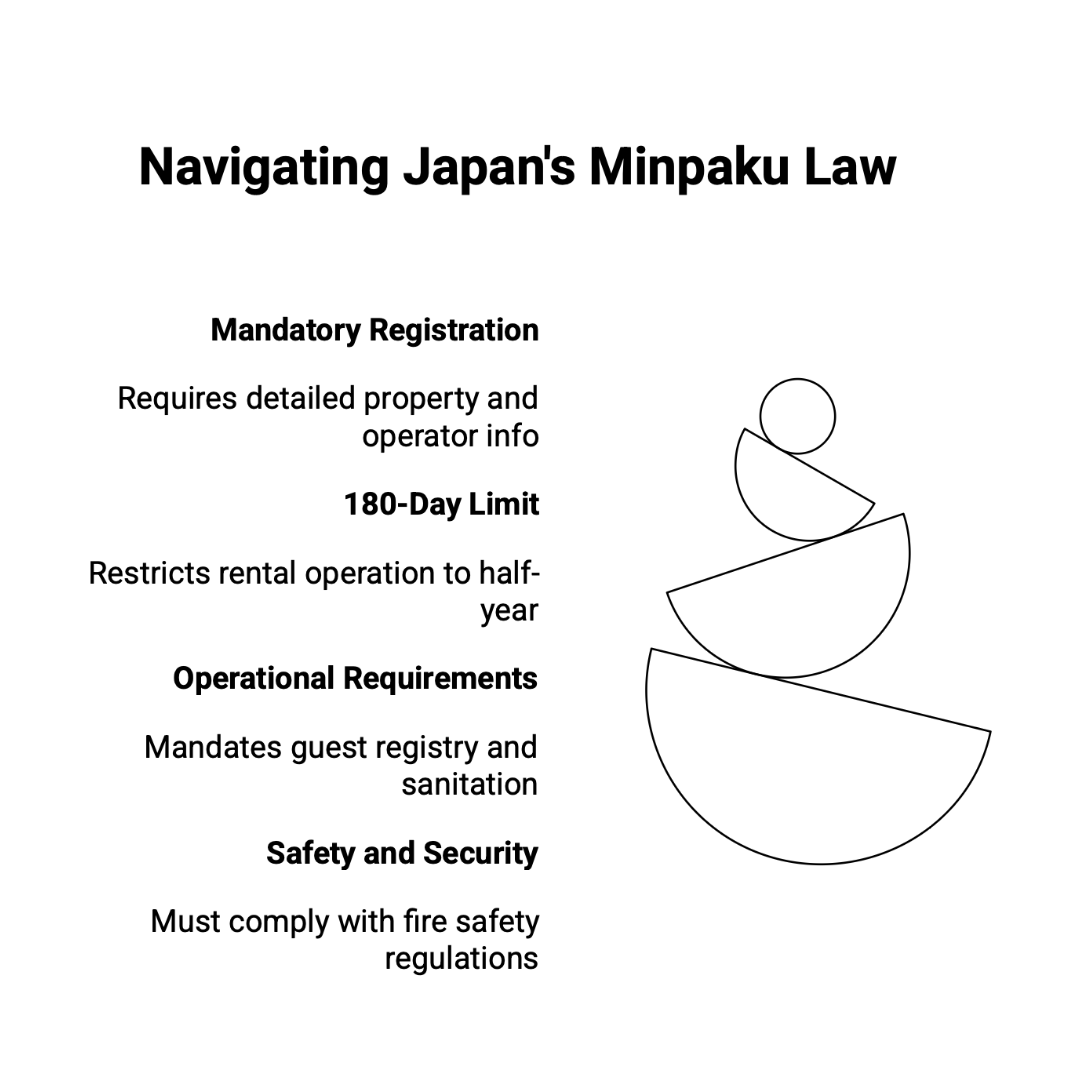
Mandatory Registration:
You cannot legally operate a short-term rental without first notifying the local government where your property is located. This process involves submitting detailed information about the property and the operator. Once approved, you receive a registration number that must be displayed on your online listing.
180-Day Annual Limit:
This is perhaps the most significant restriction. Under this law, you can only rent out your property for a maximum of 180 days per year. This cap is designed to prioritize long-term housing availability while still accommodating tourism.
Operational Requirements:
The law mandates specific operational standards. You must maintain a guest registry, ensure proper sanitation, post clear house rules, and have a system for handling complaints from neighbors. You are also required to verify guest identities and passport information for foreign visitors.
Safety and Security:
The property must comply with fire safety regulations. This may require installing smoke detectors, fire extinguishers, and emergency lighting, depending on the size and layout of your property.
For investors seeking high returns, the 180-day limit can be a major constraint on revenue potential. This is why it's crucial to evaluate other legal avenues for operating your property.
Beyond the 180-Day Limit: The Hotel Business Act
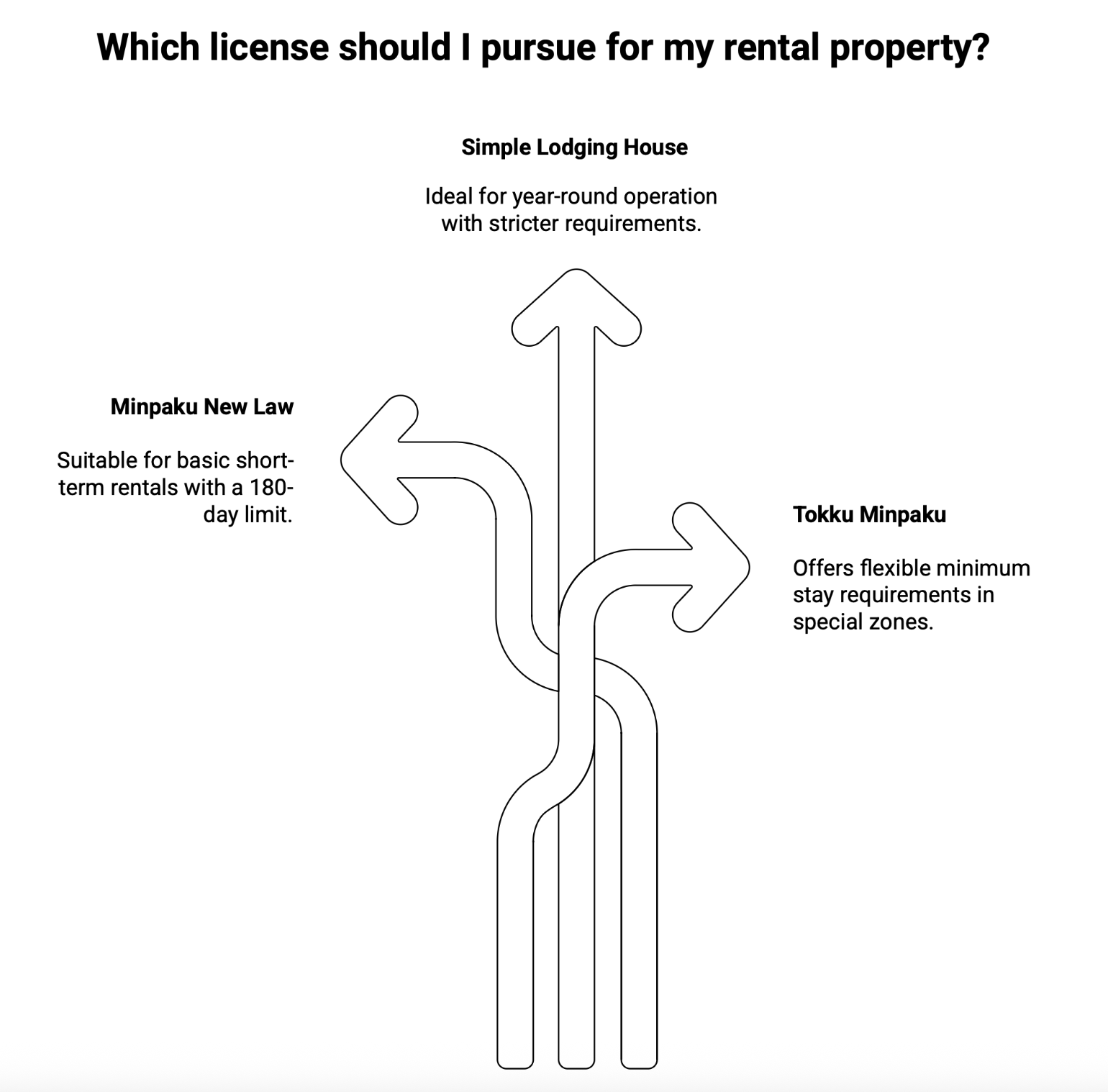
If your goal is to operate a rental property year-round, the Minpaku New Law is not your only option. You can pursue a license under the Hotel and Ryokan Management Business Act (旅館業法, Ryokan Gyoho). This is a more traditional hospitality license, and it unlocks the ability to operate 365 days a year. Let's look at the most relevant license type for investors under this act.
Simple Lodging House (簡易宿所, Kan'i Shukusho)
A Simple Lodging House license is often the preferred path for dedicated short-term rental businesses. It allows for year-round operation but comes with more stringent requirements than the basic minpaku notification.
What to expect:
Stricter Facility Standards:
The property must meet specific structural and facility requirements. This includes minimum floor space per guest, adequate ventilation and lighting, and potentially separate reception areas.
Health and Safety Compliance:
You will need to pass inspections from the local public health center to ensure the property meets high standards of hygiene and safety.
Zoning Restrictions:
Obtaining this license is often dependent on local zoning laws. Some residential areas prohibit the operation of lodging facilities.
While the application process is more demanding and may require property renovations, the reward is uncapped operational days, leading to higher ROI potential. For a serious investment focused on maximizing rental income, pursuing a Kan'i Shukusho license is a strategic move.
A Flexible Alternative: Special Economic Zones (Tokku Minpaku)
Japan has designated certain areas as National Strategic Special Zones (国家戦略特区, Kokka Senryaku Tokku) to boost economic activity by easing regulations. For real estate investors, this created what is known as Tokku Minpaku. These special zones offer a hybrid model that sits between the Minpaku New Law and the Hotel Business Act. The primary advantage is a more flexible minimum stay requirement, which bypasses the 180-day annual cap.
Key Features of Tokku Minpaku:
Minimum Stay Requirement:
Instead of an annual day limit, rentals must be for a minimum number of nights. This is typically set at two nights and three days, although the exact duration can vary by municipality.
Available in Key Cities:
Tokku Minpaku is available in high-growth areas attractive to investors, including parts of Tokyo (Ota Ward), Osaka, Fukuoka (Kitakyushu City), and Niigata. Osaka, in particular, has been a popular area for this model.
Certification Process:
Rather than a simple notification, you must apply for certification from the local government. The process is more involved than the standard minpaku registration but less complex than obtaining a full hotel license.
For investors focused on high-demand urban markets like Osaka and Fukuoka, Tokku Minpaku presents an excellent opportunity to run a compliant, year-round rental business without the intensive requirements of the Hotel Business Act.
The Local Factor: Municipal Ordinances
It's essential to understand that Japan's regulatory system is not monolithic. In addition to national laws, individual prefectures and cities can impose their own, often stricter, rules on short-term rentals. This is where localized expertise becomes invaluable.
These local ordinances can significantly impact your business operations. Examples include:
Weekday Bans:
Some popular residential areas, like in Kyoto or parts of Tokyo, restrict minpaku operations to weekends and holidays only.
School Proximity Rules:
Certain municipalities prohibit rentals within a specific distance of schools to minimize disruption.
Additional Reporting:
You may be required to notify neighborhood associations or meet with local representatives before starting operations.
Before acquiring any property, you must confirm the specific rules in that municipality. A promising investment on paper can become unworkable if local ordinances are too restrictive. This is a critical step in your due diligence process.
Tax and Legal Considerations for Foreign Investors
Operating a profitable rental business in Japan also requires a clear understanding of your tax obligations. Revenue generated from your Japanese property is subject to Japanese taxation, regardless of your country of residence.
Key Tax Obligations:
Income Tax:
The net income from your rental property (revenue minus expenses) is taxable. Non-resident investors are typically subject to a flat withholding tax rate on rental income.
Consumption Tax:
If your taxable sales exceed JPY 10 million in a given period, you may be required to register as a consumption tax business and remit this tax to the government.
Fixed Asset Tax (Property Tax):
As a property owner, you will be liable for an annual fixed asset tax and a city planning tax, which are based on the assessed value of your land and building.
Navigating the Japanese tax system can be complex. We strongly advise engaging a tax professional who specializes in real estate and foreign investment to ensure full compliance and optimize your tax position.
The Risks of Non-Compliance
Some investors might be tempted to bypass these regulations to save time and money. This is a high-risk strategy that we strongly advise against. The Japanese government has become increasingly vigilant in cracking down on illegal minpaku operations.
The consequences of non-compliance can be severe:
Fines and Penalties:
Operating without a license or registration can result in substantial fines.
Business Suspension Orders:
Authorities can order you to cease operations immediately.
Platform De-listing:
Major platforms like Airbnb will remove unregistered listings to comply with Japanese law, cutting off your access to the market.
Reputational Damage:
An enforcement action can harm your reputation as an investor in Japan.
The legal pathways are clear. A compliant operation is the only sustainable foundation for a long-term, profitable investment in Japan's short-term rental market.
The Path Forward
Japanese real estate offers exciting opportunities for capital growth, and short-term rentals can be a powerful engine for generating returns. However, success is built on a foundation of legal compliance.
Let's recap the key points:
The Minpaku New Law is the baseline, allowing rentals for up to 180 days per year with proper registration.
The Hotel Business Act offers a path to year-round operation but requires a more demanding license.
Tokku Minpaku in special zones like Osaka provides a flexible alternative with a minimum stay requirement instead of an annual cap.
Local ordinances can add further restrictions, making municipal-level due diligence essential.
Navigating these regulations requires careful planning and expert guidance. As your concierge in the Japanese real estate market, we help you identify not only the right properties but also the right legal strategy to match your investment goals.
Disclaimer: This article provides general information and does not constitute legal or tax advice. Tax laws are subject to change. Please consult with a qualified tax professional regarding your specific situation.