
Navigating Japan's Airbnb Laws: The Essential Guide for Foreign Investors
The Japanese real estate market is currently presenting a "perfect storm" of opportunity for international investors. With the yen historically weak and tourism numbers rebounding beyond pre-pandemic levels, the demand for high-quality accommodation is skyrocketing. For savvy investors, purchasing Japanese property to operate as a short-term rental (often referred to as "Minpaku") on platforms like Airbnb or Vrbo seems like a clear path to exceptional ROI.
However, the Japanese market is not the "Wild West" it once was. Following strict legislation introduced in 2018, operating a vacation rental requires rigorous adherence to complex legal frameworks. For overseas investors, navigating these rules without a local partner is nearly impossible.
At Property Concierge Japan, we believe that understanding these laws is the first step toward a successful investment. This guide breaks down the complex landscape of Japanese short-term rental regulations and explains how to navigate them seamlessly.
The Context: Why Regulation Matters
Before 2018, Airbnb in Japan existed in a legal grey area. This ended with the enforcement of the Private Lodging Business Act (Minpaku Law). While some viewed this as a restriction, seasoned investors view it as a maturation of the market. The law removed uncertainty, creating a legitimate asset class.
However, the regulations are strict. Japan prioritizes the harmony of local neighborhoods, meaning that noise complaints or improper trash disposal can lead to immediate revocation of licenses. For overseas investors, navigating these rules without a local partner is nearly impossible.
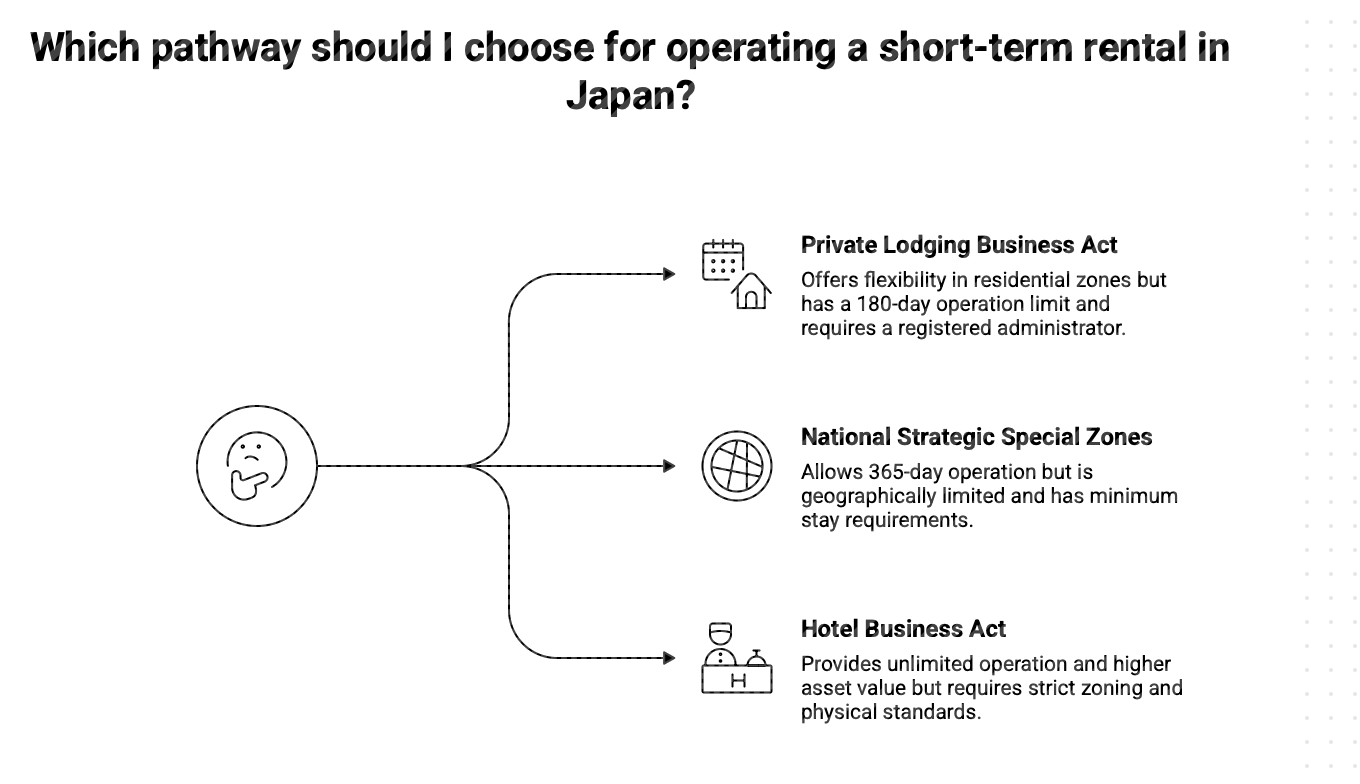
Currently, there are three primary legal pathways to legally operate a short-term rental in Japan. Choosing the right one depends on your investment goals, the property's location, and the type of building.
Pathway 1: The Private Lodging Business Act (The "New Minpaku Law")
This is the most common route for individual investors looking to rent out residential homes or apartments.
The Basics:
This law allows you to rent out a residential property (houses, condos) to guests for short periods.
The Pros:
- •Zoning Flexibility: Unlike hotels, these can often be operated in residential-only zones (Category 1 & 2 Exclusively Low-Rise Residential Zones), provided local ordinances don't say otherwise.
- •Lower Barrier to Entry: It requires a "notification" (Todokede) to the prefectural governor rather than a full permit, making the paperwork slightly less onerous than a hotel license.
The Cons (The 180-Day Rule):
The most significant limitation is the 180-day cap. You are legally restricted to operating the business for only 180 days per year (starting April 1st).
Strategy: For the remaining 185 days, the property must either sit vacant, be used by the owner, or be rented out via a standard monthly lease (which is often difficult to coordinate seamlessly).
The "Absentee" Requirement:
This is the critical point for foreign investors. If the owner does not live in the property (which applies to almost all investment properties), the law mandates that you entrust the administration to a government-registered Private Lodging Administrator. You cannot self-manage from overseas.
Pathway 2: National Strategic Special Zones (Tokku Minpaku)
For investors seeking higher yields without the 180-day cap, the "Tokku Minpaku" is a powerful alternative, but it is geographically limited.
The Basics:
Certain municipalities designated as "Special Zones" (most notably Ota Ward in Tokyo and Osaka City/Prefecture) have their own deregulation rules to accommodate tourism demand.
The Pros:
- •365-Day Operation: There is no annual cap on operating days. You can run the business year-round, significantly boosting potential revenue.
- •Zoning: Allowed in many residential areas where hotels are banned.
The Cons:
- •Minimum Stay Requirement: Guests must stay for a minimum number of nights (usually 2 nights/3 days). This excludes one-night tourists but captures families and business travelers effectively.
- •Limited Availability: This license is only available in specific designated zones. If your property is across the street from the zone border, you cannot apply.
Pathway 3: The Hotel Business Act (Simple Lodging / Ryokan License)
This is the "Gold Standard" for serious real estate investors. It treats the property as a full-fledged accommodation facility.
The Basics:
This involves obtaining a license under the Hotel Business Act, often classified as "Simple Lodging" (Kan-i-shuku-sho).
The Pros:
- •Unlimited Operation: Run 365 days a year with no minimum stay requirements.
- •Asset Value: Properties with this license often command a higher resale value because they are turnkey commercial businesses.
The Cons:
- •Strict Zoning: Generally, you cannot obtain this license in dedicated residential zones. The property must be in a commercial or quasi-commercial zone.
- •Physical Requirements: The building must meet strict fire safety codes, emergency lighting standards, and often requires a front desk (or a recognized digital alternative for remote check-in). Retrofitting a standard home to meet these codes can be expensive.
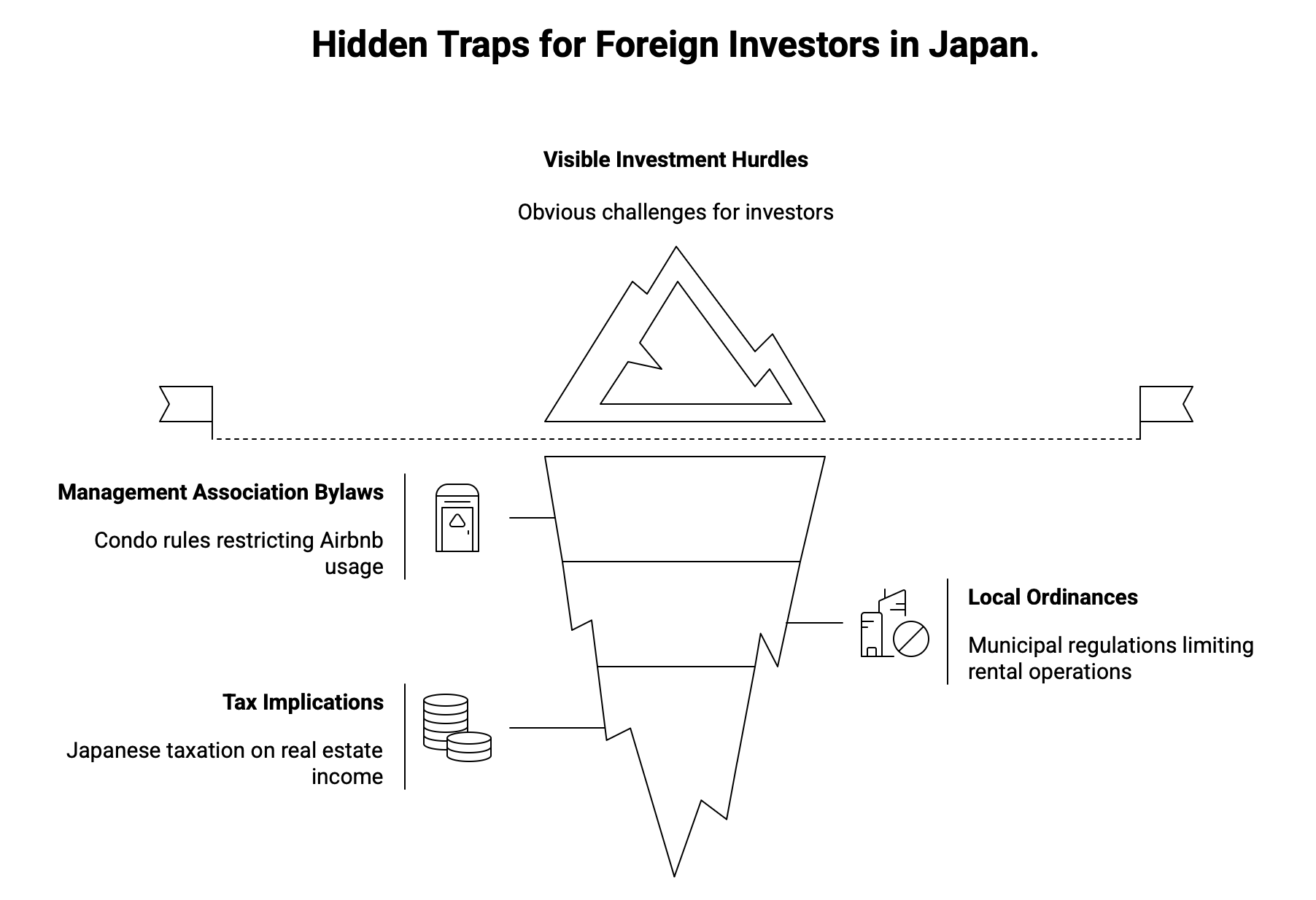
Hidden Traps for Foreign Investors
Even if you understand the three pathways above, there are "invisible" hurdles that often catch foreign investors off guard. This is where the expertise of Property Concierge Japan becomes essential.
1. The Management Association Bylaws (Condo Rules)
In Japan, owning a unit in a condominium (Mansion) does not automatically grant you the right to use it for Airbnb, even if the government law allows it.
Every building has a Management Association. If the building's bylaws (Kiyaku) prohibit sub-leasing or vacation rentals—which approximately 80% of major condos in Tokyo do—you cannot operate.
The Risk: Many investors buy a luxury condo online, only to find out later they are banned from renting it out.
Our Solution: We focus on off-market properties and pre-vetted buildings where we have confirmed that short-term rental usage is explicitly permitted.
2. Local Ordinances (The "Uwanose" Regulations)
Local municipalities can add stricter rules on top of the national law.
Example: In popular tourist hubs like parts of Kyoto or strict residential wards in Tokyo, local ordinances may restrict operation to "weekends only" or ban it entirely during school terms in residential areas.
The Risk: Buying in a "hot" area without checking the specific ward's detailed ordinances.
3. Tax Implications
Income generated from Japanese real estate is subject to Japanese taxation, regardless of where the investor resides.
- •You will likely need to file a tax return in Japan.
- •Deducting expenses (depreciation, management fees, renovation costs) requires proper bookkeeping in accordance with Japanese tax law.
The Property Concierge Japan Advantage
The complexity of these regulations highlights why a specialized partner is not a luxury—it is a necessity.
At Property Concierge Japan, we bridge the gap between foreign capital and Japanese real estate reality. Our service is designed for high-net-worth individuals who require a seamless, concierge-level experience.
How We Solve the Access Problem:
- Exclusive Off-Market Access: We do not simply browse public listings. We utilize our network to find properties (renovated Machiya, luxury condos, whole buildings) that are already compliant or eligible for high-yield licenses like the Special Zone or Hotel Business Act.
- Mandatory Local Administration: For the "New Minpaku Law," we arrange the mandatory local administrator, ensuring you meet the legal requirement for absentee owners.
- One-Stop Legal & Tax Support:
- •Visa & Immigration: Assistance for investors looking to spend more time in Japan.
- •Corporate Structure: Advice on whether to buy as an individual or establish a Japanese GK (LLC) for tax efficiency.
- •Licensing: We handle the bureaucratic heavy lifting of applying for the Fire Department inspections and Government notifications.
Conclusion
Japan remains one of the most attractive real estate markets in the world, offering stability, safety, and potential for significant yield through tourism. However, the key to unlocking this value lies in rigorous compliance and strategic asset selection.
Don't let regulatory complexity deter you from a profitable investment. With the right partner, these barriers become your protection, limiting competition and ensuring the long-term value of your asset.
Are you ready to explore off-market opportunities that are fully compliant with Japanese law?
Disclaimer: This article provides general information and does not constitute legal or tax advice. Tax laws are subject to change. Please consult with a qualified tax professional regarding your specific situation.